Colleagues collaborating at a laptop in a modern office.
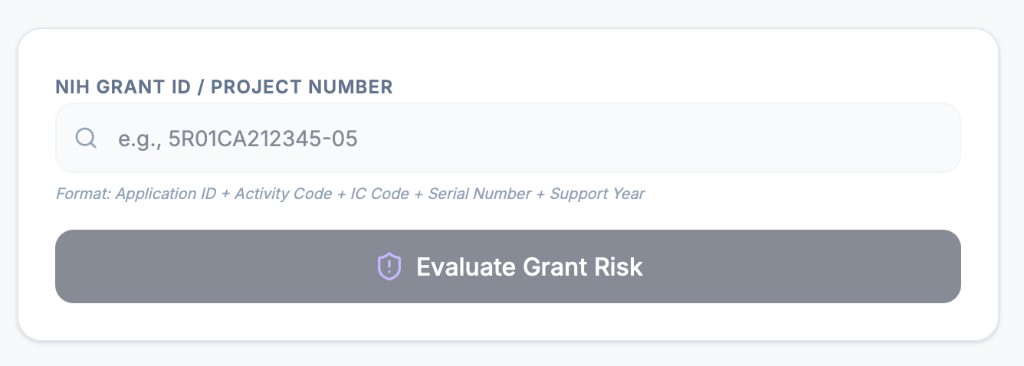
NIH grant ID lookup: search by application ID and activity code, with Evaluate Grant Risk.
Compliance intelligence for university grants

Surface grant risk before it becomes an audit finding.

complyraAI helps principal investigators and research assistants prepare for compliance reviews by auditing transaction-level spending, evaluating grant-specific risk, and translating dense regulations into clear, defensible guidance.

Line-item
Ledger Transaction Audit reviews expenses at the line-item level with exportable results and regulatory citations.
Grant-aware
Grant Risk Evaluator links NIH grant features with historical noncompliance patterns and mitigation strategies.
Human-led
Human-in-the-loop approvals and note-taking keep reviewers in control of judgment calls.
Product

Two modules, one compliance story

Module 1

Ledger Transaction Audit

Evaluates expense sheets at the line-item level, flags noncompliance risks, and cites flagged regulatory sections in the CFR.

  • Document upload and structured result export
  • Human-in-the-loop approvals and note-taking
  • Linked regulatory citations for each flagged item
Module 2

Grant Risk Evaluator

Estimates risk level and mitigation strategies for a specific NIH grant ID by connecting grant characteristics with historical noncompliance patterns.

  • Pulls grant data from the NIH RePORTER ecosystem
  • Deterministic and predictive risk methods
  • Grant-specific narrative feedback
Product walkthrough

See the workflow in action

Problem and motivation

Why compliance work needs a purpose-built assistant

Compliance audits are a central part of how university researchers account for and maintain federal grant funding; noncompliance can lead to funding freezes or clawbacks. For example, between 2021 and 2023, independent audits identified about $9.3 million in questioned costs for NIH grant awardees, with about $3.3 million repaid by researchers.1

Large universities may support teams internally, yet principal investigators and research assistants still carry much of the day-to-day burden of aligning spending and research practices with federal rules. Regulatory text and blogs are dense with legal jargon, general-purpose language models give generic or hard-to-trust answers, and external auditors are often expensive.

1 U.S. Government Accountability Office, National Institutes of Health: Monitoring of External Research Can Be Improved, GAO-25-107362 (Apr. 2025). Read the report.

Where complyraAI fits

complyraAI pairs research assistants with AI that audits transaction-level spending, scores grant-specific risk, and surfaces issues earlier—strengthening defensibility and reducing the likelihood of findings and funding loss.

Testimonials

Designed for trust, nuance, and real reviewer workflows